World Water Day 2026
Exploring Reykjavík's Water Story
Iceland is now famous for having easy access to plenty of clean, safe drinking water. This easy access did not always exist, and it took a lot of work to get here. Today, on World Water Day, we want to look back at the water story of Reykjavík to reflect on the importance of easy access to clean water that we often take for granted.
While early settlers in the area that is now Reykjavík likely found clean water with relative ease, as the city developed over the centuries, clean water became scarcer. By the end of the 19th century, Reykjavík had a serious problem ensuring its inhabitants could easily access clean water.
It is estimated that between 30-50 wells supplied the city’s residents. Each household needed to go to the wells every day to fill buckets with water. This water was for everything a household needed, including drinking, cooking, washing clothes, bathing, cleaning, and caring for any animals kept by the family. The estimated daily consumption of water in Reykjavík in 1902 was only 17 liters per day. For comparison, Icelanders today use roughly 200 liters per day.
In the 19th century, the job of collecting water was often assigned to women or children. Towards the turn of the century as houses began to have more disposable income, this role was instead taken by water carriers, who would be paid to fetch the water. This made things easier for households in some ways, but there was no running water available.
In addition to the physical logistics of carrying water into each home and business, many of the wells had additional risks due to supply and disease. Some wells reportedly dried up during periods of drought or frost, meaning those relying on the well had to travel further to get their water.
Disease was also a serious issue. Because there were no closed sewage systems in place, waste was instead channeled into open ditches that ran along many of the city streets. Many houses also had collection pits behind them. These often overflowed and leaked into the water that supplied the wells, contaminating them. The streets of Reykjavík were reportedly always dirty and had a terrible smell.
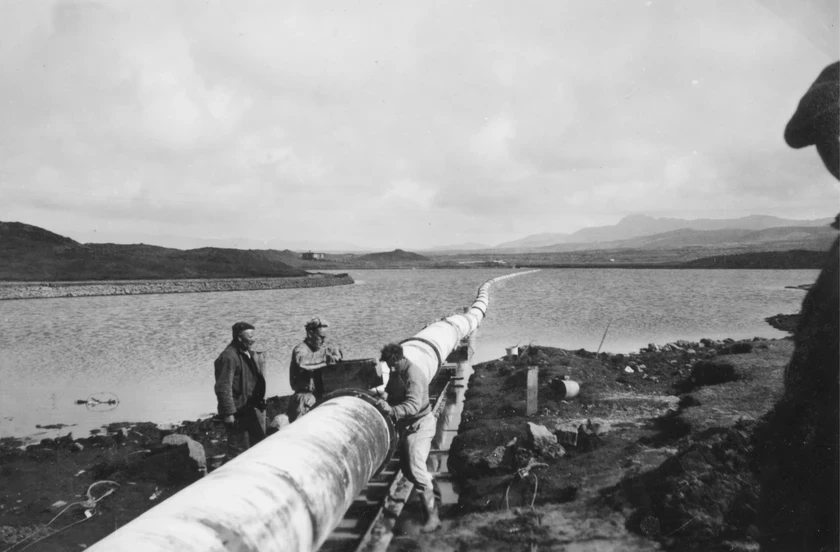
There were calls to improve access to water for the health and safety of residents (and to make the town cleaner). In 1909, the Reykjavík Water Works began operations, piping clean water from the river in Elliðaárdalur and later Heiðmörk. Around the same time, closed sewer systems were constructed in every street.
These projects directly led to improved public health, hygiene, and fire safety. Water usage increased, and the improved conditions also supported the development of industry and business in the city.
Today, Heiðmörk continues to supply Reykjavík with fresh water. It’s easy to overlook how much progress has been made in a relatively short time, and how much work still goes into maintaining our access to water.
Areas that supply fresh water must be routinely monitored, tested, and protected to prevent contamination. Maintenance must be done on pipe systems, equipment, and storage tanks to prevent any supply issues. Next time you turn on the tap, it’s worth remembering the extensive work and care that make it possible.
Increasing awareness and knowledge about the conditions and usage of water in Iceland is an important part of the LIFE Icewater project, in which Reykjavík Energy, ON Power, and Veitur take part in. You can read more about this project here.
Don’t forget – when visiting Iceland, you can fill your water bottle up straight from the tap! Iceland has some of the best drinking water in the world and it is safe and more environmentally friendly to refill a reusable water bottle.